Panel Thickness Guide: 18 mm, 21 mm and Above
Thickness is the most direct way to buy extra load capacity and the easiest way to overspend on a job that never needed it. Published guidance is short: 18 mm for heavy formwork and general use, 21 mm and above for bridges and high-load platforms. What follows is how those two numbers translate into pressure, span and pouring programme.

Key takeaways
- 18 mm covers heavy formwork and is the thickness most projects standardise on.
- Move to 21 mm and above when the pour loads a deck, a bridge soffit or a high platform.
- Published reuse for high-grade film-faced panels runs 10–20 cycles, which changes the cost per pour.
- Check thickness at four corners with a caliper on arrival; tolerance is a specification line, not a detail.
What thickness actually buys you
A thicker panel buys stiffness, and stiffness is what controls deflection under wet concrete. The phenolic film is unchanged between an 18 mm and a 21 mm sheet, and so is the core species list; what grows is the section that resists bending. Buyers who specify by thickness alone, without reference to the span being poured, either overpay or discover the limit on site.
The practical approach is to let the layout pick the thickness. A wall form with closely spaced soldiers tolerates 18 mm comfortably. A slab deck with wide bearer spacing does not, whatever the film costs.
Deflection is the variable to hold in mind, because a formwork face that bows by a few millimetres under wet concrete passes the movement straight into the finished surface. Repairs cost more than the panel: grinding a hump out of a cast wall, or filling a low spot before a floor finish goes down, is skilled labour that no thickness saving pays for.
There is a second reason to choose thickness deliberately. Concrete pressure rises with pour height and with the rate the concrete is placed, so the same panel can be comfortable on a slow wall pour and marginal on a fast column. If the pouring programme accelerates, the bearer grid and the panel thickness have to be rechecked together rather than one at a time.
18 mm: the heavy-formwork default
Published guidance names 18 mm as the heavy formwork thickness and describes it as the best overall choice. That matches what most sites do in practice: 18 mm panels, a standard bearer grid, and a panel inventory that can be reused across several floors of the same building.
Standardising on one thickness also simplifies purchasing. A single format in a single thickness keeps the panel pool interchangeable, which matters more on a busy site than a marginal saving on a second specification. Where a contractor runs more than one thickness, the thinner one usually ends up on the walls and the heavier one on the decks.
Most projects reach 18 mm by the same route. A formwork package is specified as a range of Film Faced Plywood in one or two formats, the site teams pour a trial wall, and the bearer spacing is adjusted until the measured deflection sits inside the finish tolerance. That trial is cheap, and it settles more arguments than any catalogue table.
| Thickness | Where the published guidance points | Reuse expectation |
|---|---|---|
| 18 mm | Heavy formwork and general use, described as the best overall choice | 10–20 cycles for high-grade panels |
| 21 mm and above | Bridges and high-load platforms, wide bearer spacing | 10–20 cycles with sealed edges maintained |
| 9–30 mm | The general thickness window quoted across the panel range | Depends on film weight, core and site handling |
Note the difference between the two columns. The published thickness guidance for formwork plywood is a recommendation about load and span, not a promise about service life; the reuse figure is an expectation that assumes a maintenance routine. Reading them together keeps a specification honest.
21 mm and above: bridges and high-load platforms
Above 18 mm, the published recommendation points at bridges and high-load platforms. The reason is deflection, not strength: a bridge soffit or a heavily loaded platform spreads its pressure over a wide area, and a panel that flexes under that load cannot deliver a flat concrete face.
Larger pours also punish the panel family rather than a single sheet. When a deck is cast in one pass, every panel in the run carries a share of the load, so mixing thicknesses across a single pour creates a joint line that shows up in the finish. Where a change of thickness is unavoidable, keep it at a construction joint and let the heavier sheet take the deeper section.
Thickness tolerance on arrival
Ordered thickness and measured thickness are two different numbers, and the gap is what a quality team argues about. Measure four corners and the centre of a sample panel with a caliper before the rest of the pack is opened, and compare the spread against the tolerance your own customer accepted.
Batch inspection normally records panel thickness consistency alongside core construction integrity before shipment. Ask to see that record for your consignment: it takes a supplier with an in-house testing bench a working day to produce, and it is far harder to assemble after the container has been unloaded.
Worked example: pours supported by one pack of panels
Start from the sheet and the reuse figure. A 1250 × 2500 mm panel gives 3.125 m² of face. Published reuse for high-grade film-faced panels is 10–20 cycles, so one panel serves 10 × 3.125 = 31.25 m² of concrete contact at the conservative end, or 20 × 3.125 = 62.5 m² near the top of that range.
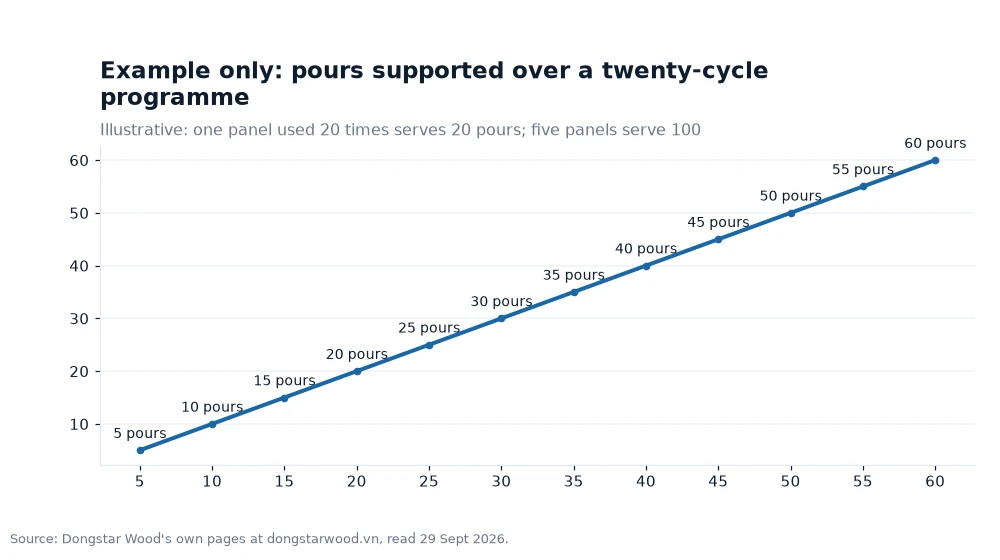
Example only: a contractor laying out 20 panels of 1250 × 2500 mm has 20 × 3.125 = 62.5 m² of formwork face. Used fifteen times each, that pack supports 20 × 15 = 300 pours' worth of panel contact, and the chart below plots the cumulative pattern for a programme built on twenty cycles. Set the thickness at 18 mm for the walls and 21 mm for the deck, and the same pack covers both without a separate purchase.
Edges, storage and the routine between pours
Reuse cycles are earned between pours. Clean the concrete off while it is still green, keep the film face free of grit, and seal damaged edges before they take water into the core. Untreated edge damage is the usual reason a panel that should have lasted fifteen cycles retires after five.
Stack flat on timber bearers under cover, never on damp ground, and separate the sheets so air moves between the faces. A pack of heavy formwork panels that has absorbed moisture will not lie flat however carefully it is nailed down.
Frequently asked questions
Is 21 mm the practical ceiling?
It is the published guidance for bridges and high-load platforms rather than the end of the range: the general thickness window is quoted across 9–30 mm, and the film-faced category standardises 18 mm and 21 mm for formwork work.
Can 18 mm and 21 mm panels be mixed in one pour?
They can, but the joint between them behaves differently under load, and cast concrete tends to show that line. Contractors who mix thicknesses usually keep the change of thickness at a construction joint. Mixing formats inside one thickness is the safer form of flexibility.
How do I check deflection on site before a pour?
Load the bearer grid and measure mid-span with a dial gauge or a taut line, then compare against the flatness your finish requires. If the deck flexes under its own preparatory load, the thickness or the bearer spacing is wrong and more panels will not fix it.
Choosing between two thicknesses
When the choice sits between 18 mm and something heavier, price the programme rather than the sheet. Buyers comparing the two usually work from the economical black panel option for short cycles and from the mill's own production background when they want to know which lines press the heavy formats, then decide on the pour schedule instead of the catalogue.
Thickness and reuse figures in this guide are taken from that that that company's own pages, as checked on 29 Sept 2026 for the values in this article for the values in this article for the numbers in this guide[1].