A Supplier Scorecard for Fragrance Manufacturing: Evidence, Not Impressions
Most supplier evaluations fail because they score the pitch rather than the process. A well-prepared factory presents certificates, a tasting session and a confident account manager, none of which tells you whether a bulk batch will match the approved sample in nine months. A scorecard built on evidence — records, retained samples, documented scope and market paperwork — is harder to fill in and much better at predicting what the relationship will be like in year two.
Key takeaways
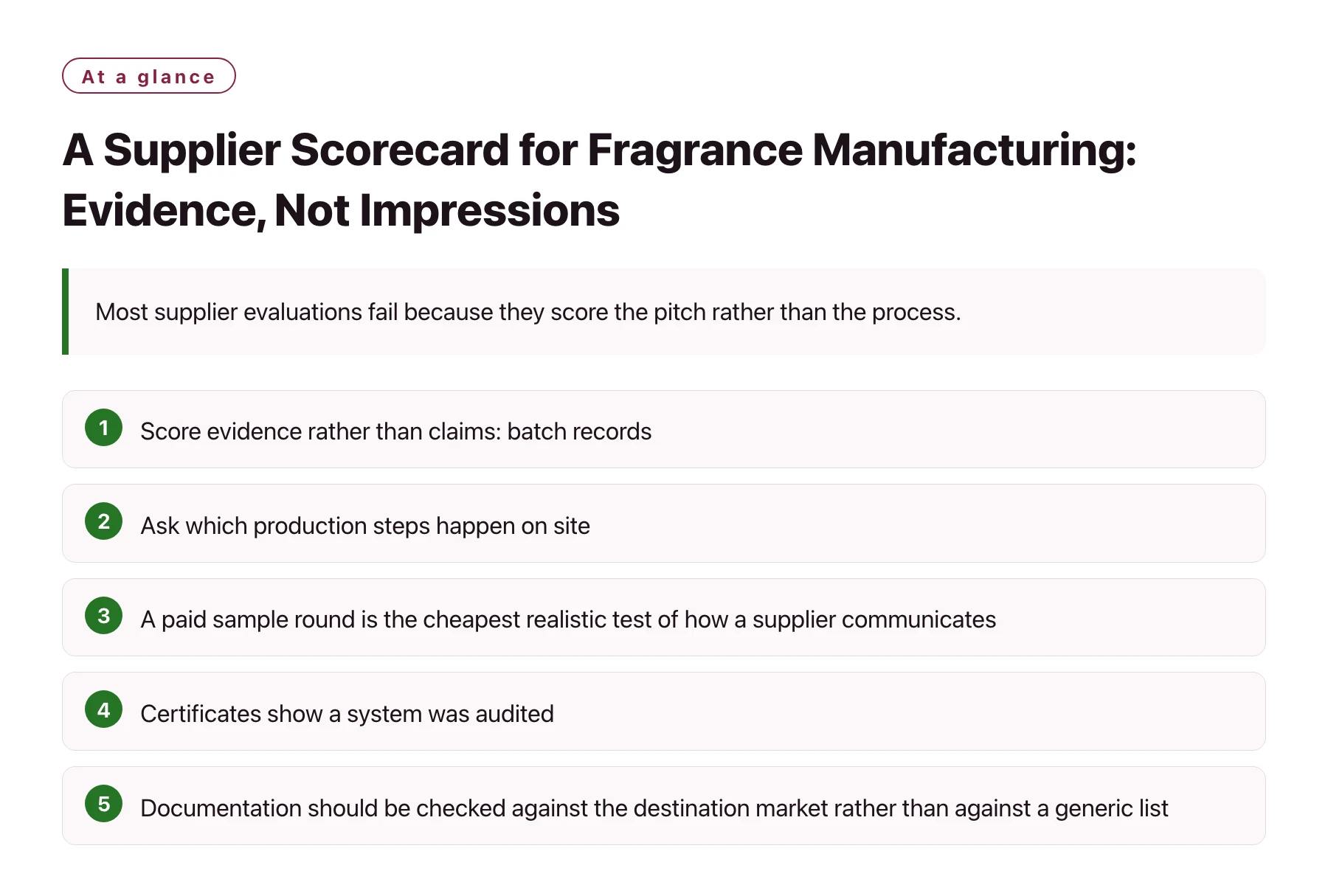
- Score evidence rather than claims: batch records, retained samples and a written scope of work are what distinguish a manufacturer from a coordinator.
- Ask which production steps happen on site, because subcontracted steps add lead time and points of failure the brand still owns.
- A paid sample round is the cheapest realistic test of how a supplier communicates, revises and keeps to a date.
- Certificates show a system was audited; batch records show what happened on a specific run, and the second is what a brand can actually verify [1].
- Documentation should be checked against the destination market rather than against a generic list, since obligations vary by where the product is sold [2].
Sourcing teams usually start with a spreadsheet of capabilities and prices. That is a reasonable first filter, and it is a poor basis for a decision, because the columns describe what a supplier says it can do rather than what it does on a Tuesday afternoon when a batch is out of specification.
A scorecard helps mainly by forcing the evaluation to name its evidence. Each dimension gets a definition of what proof looks like, and if no proof is available, the dimension scores low no matter how good the meeting felt.
Why price-led evaluation misleads
Price is comparable, which makes it attractive as a decision variable, but a fragrance quotation reflects scope rather than efficiency. Two suppliers quoting the same unit price may be quoting different fill sizes, different concentrations or different packaging routes.
The deeper problem is that the expensive failures are not price failures. They are mismatches: an approved sample that cannot be repeated, a documentation pack that satisfies nobody, a launch date that moves because a subcontracted step slipped. Those risks are visible before the contract, but only if the evaluation asks for records rather than assurances.
The scorecard, with evidence defined
| Dimension | Evidence that counts | Warning sign |
|---|---|---|
| Scope of work | A written list of which steps are in house and which are bought in | Vague answers about how production is organised |
| Process control | A batch record walked through from intake to release | Certificates offered instead of records |
| Sampling discipline | A named approval step, a retained reference sample, a revision log | Approval by photograph and no retained sample |
| Quality testing | Named tests, named laboratories, results shared with the brand | Testing described only as standard |
| Market paperwork | A routine document pack for your destination market | Documents assembled case by case after the order |
| Commercial clarity | Lead times, minimum quantities and payment stages in writing | Figures that change as the conversation progresses |
A supplier can score well on price and badly on the second and fifth rows, and that combination is the one that costs a launch. Weight the rows before scoring, not after.
Running the evaluation so it produces a real answer
A scorecard is only as good as the process around it. Three habits make the difference between a completed form and a decision the team can defend later.
Score the process, not the presentation
Ask to walk through one batch record from raw material intake to release. A manufacturer that works to a cosmetics GMP framework such as ISO 22716 keeps that traceability as routine rather than as a special exercise, and the document will be available on request [1]. If a supplier can only talk about the audits it has passed, the process dimension is unanswered, not failed — but it stays unanswered on the scorecard.
Use one paid sample as the test
A trial sample is not a free favour, it is a small procurement, and paying for it changes the relationship in a useful way: the supplier treats it as work and the brand can hold it to a date. What the trial reveals is rarely the scent alone. It shows how comments are received, whether a revision arrives when promised, and whether the accompanying paperwork matches what was agreed.
Check the paperwork against the market, not a generic list
Documentation requirements follow the destination market. In the European Union the finished product has to satisfy that market's cosmetics regime, and the obligations fall on the party placing it on the market, which is normally the brand [2]. A supplier that exports regularly to your region will have a routine answer; one that improvises is telling you something about its operating experience.
Keeping the scorecard useful after the first order
Score three suppliers with the same scorecard and the same written brief, then compare the evidence column rather than the total. A supplier that scores moderately everywhere, with documents to support each answer, is usually a safer first partner than one that scores highly on price and presentation with nothing behind it.
The evaluation should not end when the contract is signed. The same dimensions that were scored before the first order are the ones that predict the second: whether the approved sample was repeated, whether the quoted lead time held, whether the document pack arrived complete.
It helps to keep a short version of the scorecard and revisit it after each production run. Over a year, that record becomes more informative than the original assessment, because it reflects behaviour rather than capability. A supplier that was average on paper but has hit every date and every specification for three runs is a better partner than a supplier whose presentation was excellent and whose first bulk order drifted.
Where the relationship involves several products, the scorecard also shows where a brand is unusually dependent. If one supplier holds the formula, the mould and the artwork for the whole range, adding a second qualified partner is a risk decision rather than a loyalty question. Reviewing the questions to ask a perfume factory before the first order is the practical version of that exercise, and checking a manufacturer's published Xuelei Cosmetics service scope against your own list of requirements is a quick way to find the questions you have not thought to ask.
What to do when a supplier scores poorly
A low score is not automatically a rejection. It may mean the supplier is a good fit for a different scope — a standard private label range rather than a bespoke formula, for example. What matters is that the mismatch is named before the contract rather than discovered during the first production run, when changing partner costs a tooling order and a season.
Sources
- SGS: Cosmetics, Personal Care & Household Testing —— Testing, inspection and certification services for cosmetics and personal care, including microbiological, stability and safety testing aligned with cosmetics GMP.
- European Commission: Cosmetics in the EU —— The European Commission's overview of EU cosmetics rules, including the responsible person, product information file and safety report requirements.
Frequently asked questions
How many fragrance suppliers should I evaluate?
Three is a practical number: enough to see how the market responds to the same brief, few enough to keep the evidence comparison honest. Send an identical written brief and ask each supplier to restate the scope before quoting.
What is the single most useful document to request?
One batch record, taken through from raw material intake to release. It shows whether traceability is routine, whether testing is documented and whether the supplier can explain its own process without preparation.
Are certifications enough to qualify a manufacturer?
No. A certificate shows that a management system was audited against a standard at a point in time. It does not show what happened on your batch, which is why records and retained samples carry more weight in an operational evaluation.
Should I pay for a trial sample?
Yes, in most cases. A paid sample becomes a small piece of work with a date attached, which makes it a genuine test of responsiveness. Free samples tend to arrive with little explanation and no commitment on either side.
How do I evaluate a supplier for a market I have not sold in before?
Compare the supplier's routine document pack against the requirements of that market, and ask which parts of the process change. A supplier that already ships there will answer from habit; one that has to research the question is not necessarily unsuitable, but the learning time belongs in the project plan.