An 18-Hour Payout Run, From Share to Spendable Balance
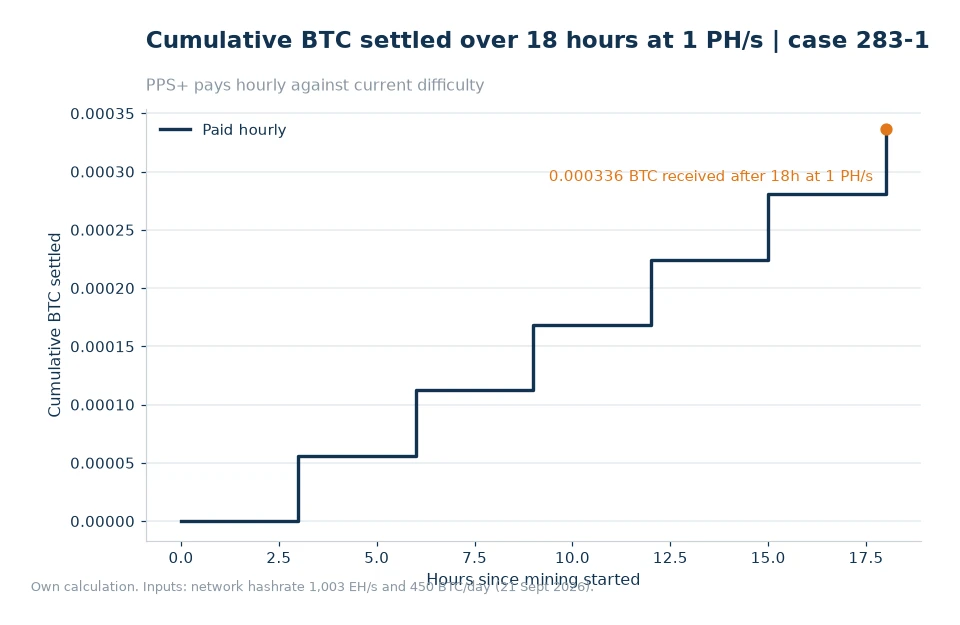
Not every reconciliation needs a full day. Eighteen hours covers two working shifts and still shows a clean pattern: at 1 PH/s the pool credits 1.869e-05 BTC each hour, so the run ends at 0.00033645 BTC, about $28.50 at $84,692. For someone who checks a rig between shifts, that is enough evidence to judge whether the setup is healthy.

Key takeaways
- A three-hour slice at 1 PH/s is 5.608e-05 BTC, or roughly $4.75 at the September price.
- Eighteen hours of PPS+ credits total 0.00033645 BTC, with every hour settled separately.
- Wallet balances can hold several mined coins at once, including merged-mining output, in one account.
- Converting a balance is a separate decision from earning it, and it can wait until the run is complete.
A window shorter than a settlement day
Pool arithmetic is usually explained in days, which suits planners and irritates anyone standing in front of a machine. A day is too long to wait when a board was just swapped, and too short to be meaningful when a facility runs continuously. Eighteen hours sits between the two: long enough to include a difficulty boundary and a couple of confirmation cycles, short enough to act on during the same shift.
What makes the window useful is that PPS+ does not batch. The block-reward side settles against current difficulty every hour, so an 18-hour run produces eighteen separate entries rather than one total. Each entry is small — 1.869e-05 BTC at 1 PH/s — and each one is evidence. A missing entry narrows the fault to a single hour instead of a whole day.
That granularity also keeps a small operator honest about downtime. A reboot for a firmware update, a breaker reset, a fan swap: each is easy to forget and each shows up as a slightly smaller step. Reconstructed over a month, those steps add up to a number that is hard to argue with and easy to fix.
Why eighteen hours is a fair test
A shorter window invites two objections. The first is rounding: small numbers look noisy when expressed in dollars. The second is luck, since any window where payment depends on blocks found will swing. Under PPS+ the second objection largely disappears, because the hourly credit is priced against difficulty rather than against what the pool found. Luck belongs to PPLNS, which waits for six confirmations and spreads value across the last five difficulty rounds.
Rounding is easier to handle than it looks. Work in bitcoin and convert once, at the end. Doing the conversion on every line multiplies rounding error and makes a clean run look uneven. The table below keeps the arithmetic in satoshi-scale decimal for that reason, with a single dollar column for orientation.
It also helps to know what normal looks like before judging an 18-hour slice against it. The live pool state shows how the pool's hashrate and luck have moved, so a soft afternoon can be read as a network-wide pause rather than a fault on your rack.
Hourly checkpoints for the run
Four points are enough to see the shape. Each three-hour block adds the same amount because the example holds difficulty constant; the next estimate of −2.12% would make later blocks marginally larger.
| Hour mark | Added in the last 3 h | Run total | Dollar value |
|---|---|---|---|
| 3 h | 5.608e-05 BTC | 0.00005608 BTC | $4.75 |
| 9 h | 5.608e-05 BTC | 0.00016823 BTC | $14.25 |
| 15 h | 5.608e-05 BTC | 0.00028038 BTC | $23.75 |
| 18 h | 5.608e-05 BTC | 0.00033645 BTC | $28.50 |
Read the second column first. A constant figure is the signature of an uninterrupted worker. If one row is smaller, the machine was offline for part of that block, and the shortfall tells you roughly how long. That is a more useful diagnosis than a monthly average, which hides a four-hour outage inside thirty days of good performance.
Worked example
The run builds from the network total, so every figure can be checked independently.
- Each terahash accounts for 450 ÷ 1,003,000,000 = 0.00000044865 BTC daily.
- At 1 PH/s, or 1,000 TH/s: 1,000 × 0.00000044865 = 0.00044861 BTC a day.
- One hour of settlement: 0.00044861 ÷ 24 = 0.00001869 BTC.
- Three hours: 3 × 0.00001869 = 0.00005608 BTC, or $4.75.
- Eighteen hours: 18 × 0.00001869 = 0.00033645 BTC.
- In dollars: 0.00033645 × 84,692 = $28.49, rounded to $28.50 in the chart note.
- Scaling check: at 0.5 PH/s the same run yields 0.00016823 BTC, half of the total.
Several coins under one roof
A wallet attached to a mining account has to cope with more than bitcoin. Merged mining produces two coins from one hash run, and an operator running LTC/DOGE alongside a BTC machine ends up with balances in currencies they never explicitly chose. Keeping those balances in the same account as the mining dashboard avoids a second login and a second set of addresses to guard.
The ViaBTC Crypto Wallet is built around that arrangement: deposits and withdrawals for the coins the pool supports, inside the account that already shows hashrate and credits. For an 18-hour check, the practical benefit is one screen. You can see the BTC run finish and the merged-mining balance beside it without exporting anything.
Converting later rather than sooner
Auto Conversion exists for people who would rather not watch several balances. It converts one coin into another on a set rule, which turns a multi-coin wallet into a single running total. That is convenient, and it is also a decision made once and then forgotten, which is why it deserves five minutes of thought before it is switched on.
The alternative is to leave balances alone and convert when there is a reason: a hardware purchase, a bill, or a rebalance. Neither approach changes what mining produced. They differ in when a price is locked and how much attention the operator spends on the wallet. An 18-hour run is a good moment to look at both columns, the mined total and the converted total, and decide which one you actually want to manage.
Before setting a conversion rule, price the output it will act on. The Profit Calculator gives a daily estimate at your hashrate, which is the number a conversion schedule is really working with. A rule that converts every payment no matter its size will trade small amounts often; one with a floor will trade rarely and in larger blocks. Only the second behaves like a treasury decision, and only the second is worth automating.
Frequently asked questions
Why does an 18-hour run pay 18 times instead of once?
Because PPS+ settles the block-reward component hourly against current difficulty. At 1 PH/s each hourly step is 0.00001869 BTC, so eighteen steps total 0.00033645 BTC.
Is a short run enough to spot a failing machine?
Usually yes. A worker that stops submitting removes its hourly step, and the gap is visible within one three-hour block. Persistent hashrate loss below that threshold is easier to catch with an alert.
Can I hold merged-mining coins in the same wallet?
Yes. The multi-currency wallet sits inside the same account as the mining dashboard and covers the coins the pool supports, so merged-mining output does not require a separate service.
Set the first checkpoint before the next shift
Before the next shift, note the run total and the hour it was recorded. Eighteen hours later, subtract and compare with 0.00033645 BTC at 1 PH/s. A close match means the machine, the worker name and the payout path all agree. A shortfall means one of them does not, and finding out which is far cheaper at 18 hours than at the end of a month.
Sources: wallet scope and the published rate sheet on viabtc.com[1]. Numbers for 21 Sept 2026: 1,003 EH/s network, 3.125 BTC subsidy, 144 blocks daily, BTC $84,692. Read that day and published 24 Oct 2026; totals presume eighteen uninterrupted hours and no difficulty change.